
Why Winter Is a Good Time to Test Your Home for Radon in Western NC
November 21, 2026
When the weather turns cold up here, folks close the windows, fire up the heat and stay inside a lot more. That's exactly when I like to talk to people about radon. Not because it's scary, but because winter makes it simple to get a good, clean test, and because the only way to know your number is to test.
I've been around houses since 2001, building them, remodeling them and now inspecting them across Asheville and Western North Carolina. Radon is one of the few things in a house I can't see, smell or point a flashlight at. So let me walk you through it the way I would if we were standing in your basement together.
What radon is, in plain terms
Radon is a natural radioactive gas that comes up out of the rock and soil. Outdoors it thins out. Inside a house it can build up, and it gets in through the foundation, crawl space, slab cracks and gaps around pipes.
Here's why it matters. The EPA says radon is the second leading cause of lung cancer overall and the number one cause among people who have never smoked, and it estimates radon is responsible for about 21,000 lung cancer deaths a year in the U.S. (EPA, Health Risk of Radon). NCDHHS puts the North Carolina number at about 480 deaths a year (NCDHHS, Dec 30, 2025).
How radon risk compares (EPA's chart)
A lot of my clients relate to it this way: they've heard all their lives about what smoking does to your lungs, and radon works on the same lungs. EPA's own chart lays it out for people who smoke and people who never have, level by level, and it compares the risk to things we all worry about, like a car crash or a house fire. I'd rather you see EPA's numbers than take my word for it.
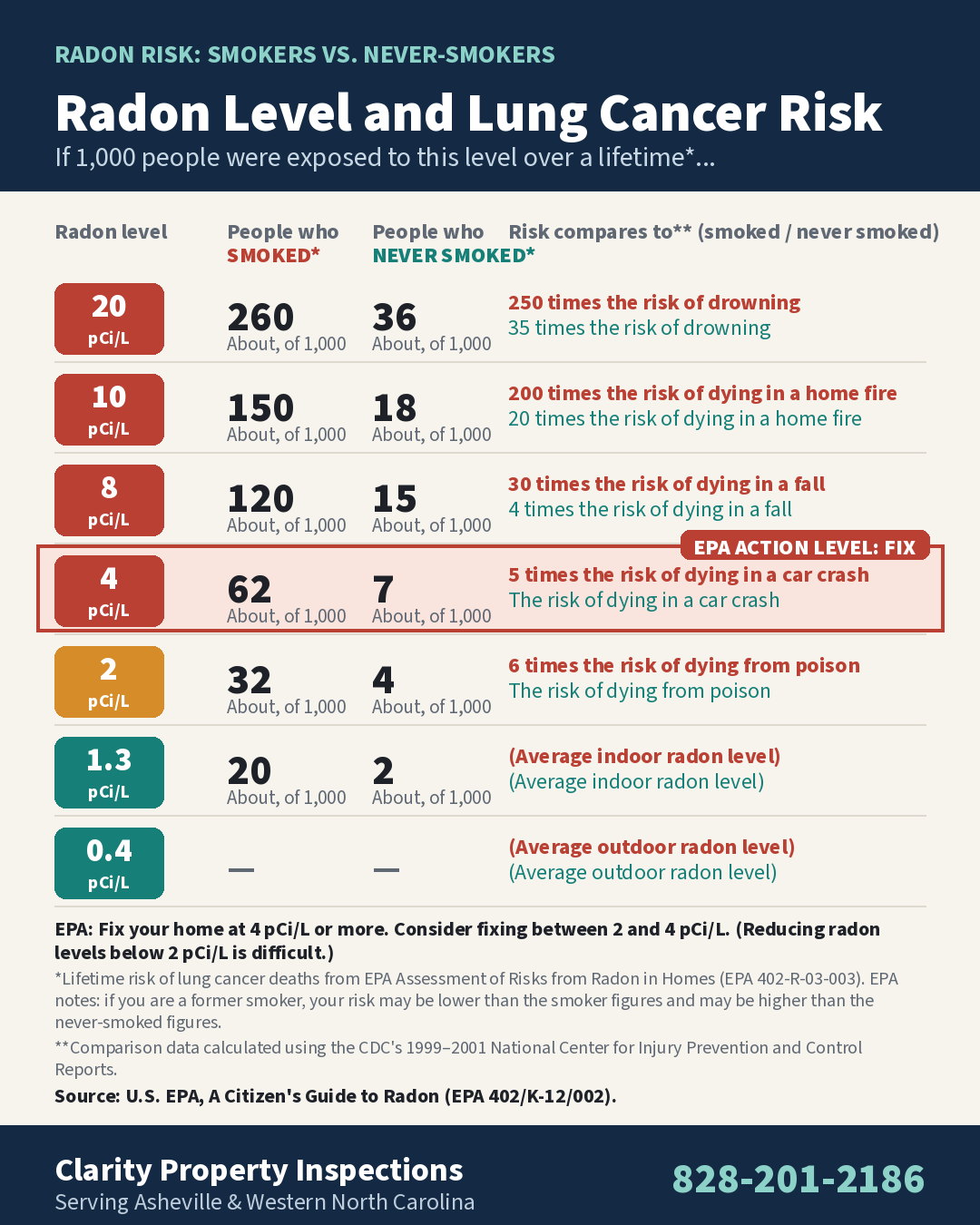
- 20 pCi/L — If 1,000 people who smoked were exposed over a lifetime*: About 260 people could get lung cancer; Risk compares to**: 250 times the risk of drowning; If 1,000 people who never smoked were exposed over a lifetime*: About 36 people could get lung cancer; Risk compares to**: 35 times the risk of drowning; What to do: Fix your home
- 10 pCi/L — If 1,000 people who smoked were exposed over a lifetime*: About 150 people could get lung cancer; Risk compares to**: 200 times the risk of dying in a home fire; If 1,000 people who never smoked were exposed over a lifetime*: About 18 people could get lung cancer; Risk compares to**: 20 times the risk of dying in a home fire; What to do: Fix your home
- 8 pCi/L — If 1,000 people who smoked were exposed over a lifetime*: About 120 people could get lung cancer; Risk compares to**: 30 times the risk of dying in a fall; If 1,000 people who never smoked were exposed over a lifetime*: About 15 people could get lung cancer; Risk compares to**: 4 times the risk of dying in a fall; What to do: Fix your home
- 4 pCi/L (EPA action level) — If 1,000 people who smoked were exposed over a lifetime*: About 62 people could get lung cancer; Risk compares to**: 5 times the risk of dying in a car crash; If 1,000 people who never smoked were exposed over a lifetime*: About 7 people could get lung cancer; Risk compares to**: The risk of dying in a car crash; What to do: Fix your home
- 2 pCi/L — If 1,000 people who smoked were exposed over a lifetime*: About 32 people could get lung cancer; Risk compares to**: 6 times the risk of dying from poison; If 1,000 people who never smoked were exposed over a lifetime*: About 4 people could get lung cancer; Risk compares to**: The risk of dying from poison; What to do: Consider fixing between 2 and 4 pCi/L
- 1.3 pCi/L — If 1,000 people who smoked were exposed over a lifetime*: About 20 people could get lung cancer; Risk compares to**: (Average indoor radon level); If 1,000 people who never smoked were exposed over a lifetime*: About 2 people could get lung cancer; Risk compares to**: (Average indoor radon level); What to do: (Reducing radon levels below 2 pCi/L is difficult)
- 0.4 pCi/L — If 1,000 people who smoked were exposed over a lifetime*: —; Risk compares to**: (Average outdoor radon level); If 1,000 people who never smoked were exposed over a lifetime*: —; Risk compares to**: (Average outdoor radon level); What to do: (Reducing radon levels below 2 pCi/L is difficult)
EPA's notes: if you are a former smoker, your risk may be lower than the smoker figures and may be higher than the never-smoked figures. *Lifetime risk of lung cancer deaths from EPA Assessment of Risks from Radon in Homes (EPA 402-R-03-003). **Comparison data calculated using the CDC's 1999–2001 National Center for Injury Prevention and Control Reports.
Source: U.S. EPA, A Citizen's Guide to Radon (EPA 402/K-12/002), https://www.epa.gov/sites/default/files/2016-12/documents/2016_a_citizens_guide_to_radon.pdf
Every kind of house should be tested, not just homes with basements. The NC Radon Program says that includes homes on crawl spaces, slabs, condos, townhomes and manufactured homes (NC Radon Program).
Why winter makes testing easier
A short-term radon test has to run under what EPA calls closed-house conditions: windows and outside doors shut (normal coming and going is fine), and for tests under four days, the house closed up for at least 12 hours before the test starts (EPA measurement protocols).
In July, that's a big ask. You've got windows open, the screen door propped and the box fan running. In January, most homes in the mountains are already closed up. Your furnace or heat pump can keep running normally, so you're not giving anything up to get a valid test.
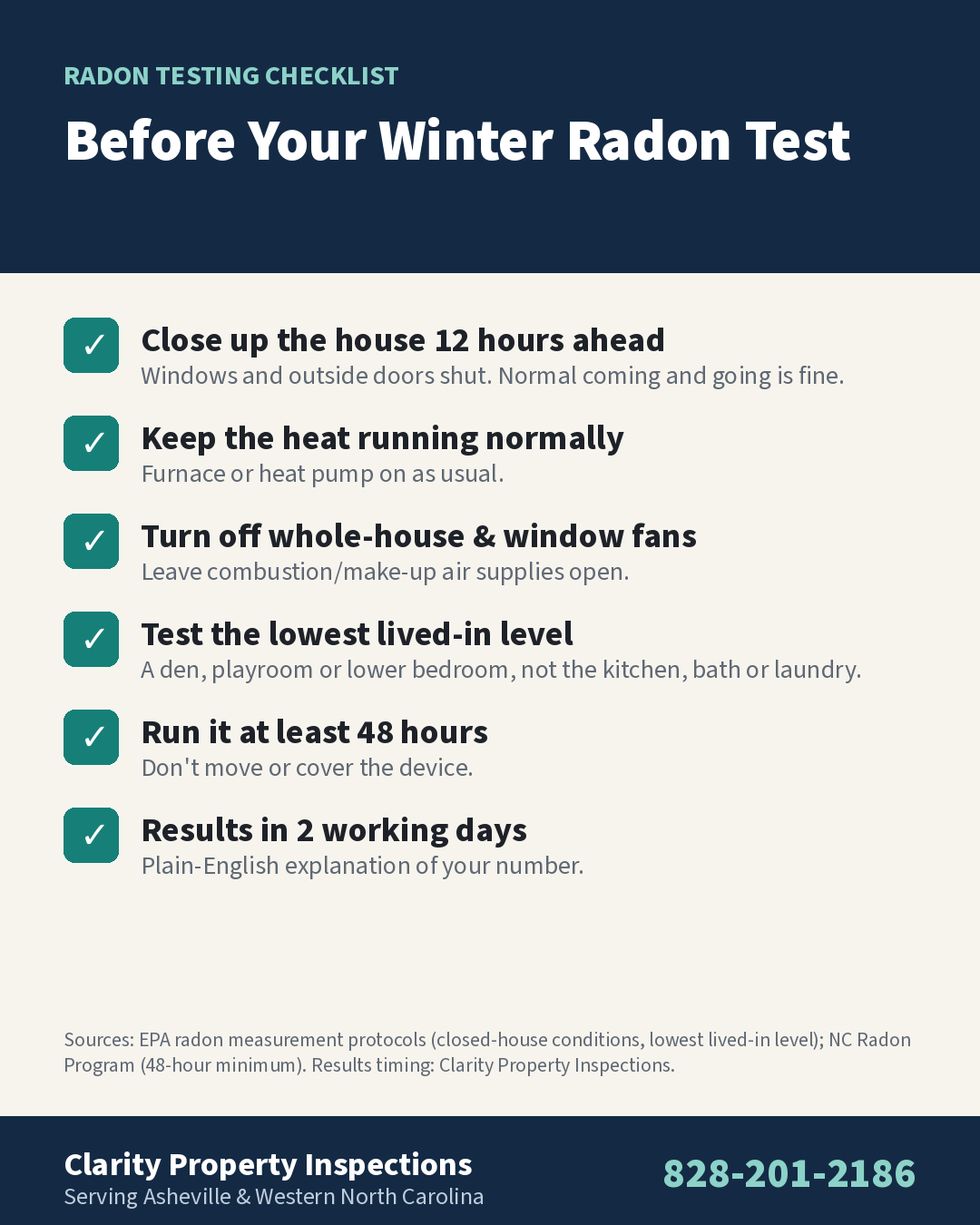
It's also the season you spend the most hours inside breathing that air. And it lines up with January being National Radon Action Month, when the state puts radon in the news.
How common is high radon around here?
The honest answer: it varies house to house, even on the same road. But the numbers say it's worth checking in our counties.
The NC Radon Program recommends testing both indoor air and private well water in Buncombe, Haywood, Henderson and Madison counties (NC Radon Program county recommendations).
Lab-reported test results from 2008 to 2017 (CDC Tracking Network data) show these shares of tested buildings at or above the EPA action level of 4 pCi/L:
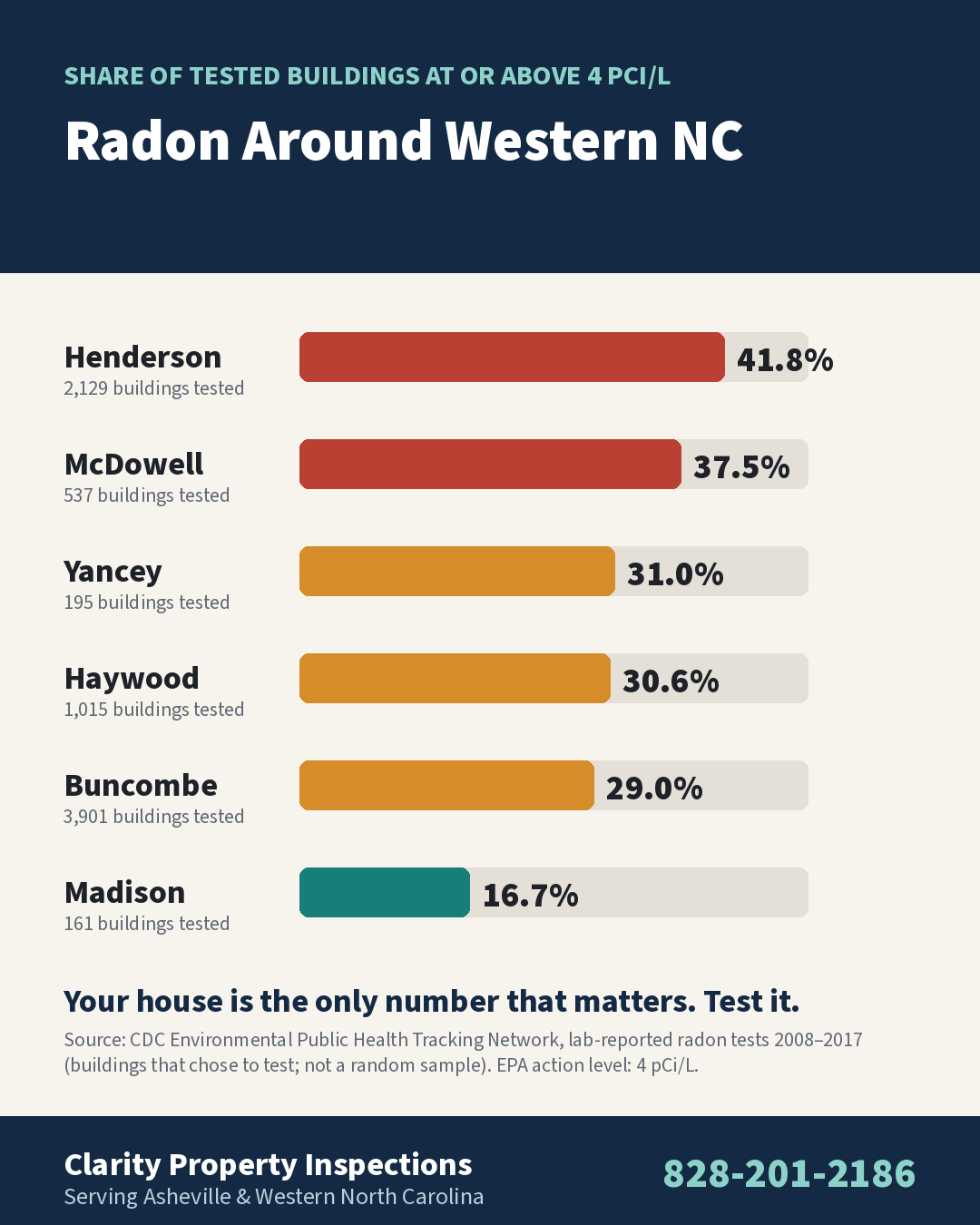
- Henderson: 2,129 buildings tested, 41.8% at or above 4 pCi/L
- McDowell: 537 buildings tested, 37.5% at or above 4 pCi/L
- Yancey: 195 buildings tested, 31.0% at or above 4 pCi/L
- Haywood: 1,015 buildings tested, 30.6% at or above 4 pCi/L
- Buncombe: 3,901 buildings tested, 29.0% at or above 4 pCi/L
- Madison: 161 buildings tested, 16.7% at or above 4 pCi/L
Source: CDC Environmental Public Health Tracking Network, "Radon Tests from Labs," percent of pre-mitigation tests at or above 4 pCi/L and number of buildings tested, 2008–2017 (https://ephtracking.cdc.gov/). These are buildings that chose to test, not a random sample, so treat them as a reason to test, not a prediction for your house.
The NC Radon Program says it plainly: radon levels are highly site-specific and the only way to know a building's level is to test it (NC Radon Data).
How a radon test works with me
- You call or book online and we pick a window.
- I'll remind you about closed-house conditions starting 12 hours before I arrive.
- I place the test in the lowest level of the home you actually use, like a den, playroom or lower bedroom. EPA protocol points to the lowest lived-in level and steers away from kitchens, bathrooms and laundry rooms.
- The test runs at least 48 hours. The NC Radon Program recommends no less than 48 hours on the lowest occupied level (Testing for Radon).
- I pick it up, and your radon results come back in 2 working days with a plain-English explanation.
If you're on a private well in Buncombe, Haywood, Henderson or Madison County, ask me about well water testing at the same visit. Water results take 3 to 4 working days.
What your number means
- Below 2 pCi/L: You're in good shape. Retest in a couple of years, or after big changes like finishing a basement.
- 2 to 4 pCi/L: Below the action level. The NC Radon Program notes many homes can be brought to 2 pCi/L or lower, so consider fixing if you're in this range.
- 4 pCi/L or higher: EPA's action level. The NC Radon Program recommends a follow-up test, then fixing the home if the confirmed level is 4 or more. If the first short-term result is more than twice the action level, it recommends a second short-term test right away.
A high number isn't the end of the world. Radon mitigation systems are a common, well-understood fix, and the state recommends a retest after a system goes in, no sooner than 24 hours and no later than 30 days after it's turned on (Radon Mitigation). I'm happy to do that independent retest.
Buying a home this winter?
If you're under contract, add radon testing to your home inspection. Radon results come back in 2 working days, which usually fits inside your due diligence period. Your inspection report itself is delivered within 24 hours, and single-family homes I inspect are covered by the InterNACHI Buy-Back Guarantee.
Frequently asked questions
Is winter really a good time to test for radon?
Yes. A valid short-term test needs closed-house conditions, and in winter most homes are already closed up with the heat running. You can test any time of year as long as those conditions are met.
My house is on a crawl space. Do I still need to test?
Yes. The NC Radon Program recommends testing all home types, including homes on crawl spaces and slabs, condos, townhomes and manufactured homes.
How long does a radon test take?
The test runs at least 48 hours on the lowest lived-in level. With Clarity, results are ready in 2 working days after pickup.
What radon level is too high?
EPA's action level is 4 pCi/L. If a test comes in at 4 or higher, the NC Radon Program recommends a follow-up test and fixing the home if the confirmed level is 4 or more. It also suggests considering a fix between 2 and 4 pCi/L.
Do you test radon in well water too?
The NC Radon Program recommends testing both indoor air and private well water in Buncombe, Haywood, Henderson and Madison counties. I offer well water testing, with results in 3 to 4 working days.
Book your winter radon test
I'm Kurtis Lane, NC Home Inspector License #5741 and InterNACHI Certified Professional Inspector. If you've been meaning to test, this is the season to do it.
- Call or text: 828-201-2186
- Book online: https://app.spectora.com/home-inspectors/my-inspection-company-cee2ccb4d2/schedule
- See current pricing: https://www.clarityinspectors.com/price-list
- Learn more: https://www.clarityinspectors.com/radon-inspections
Serving Asheville & Western North Carolina.